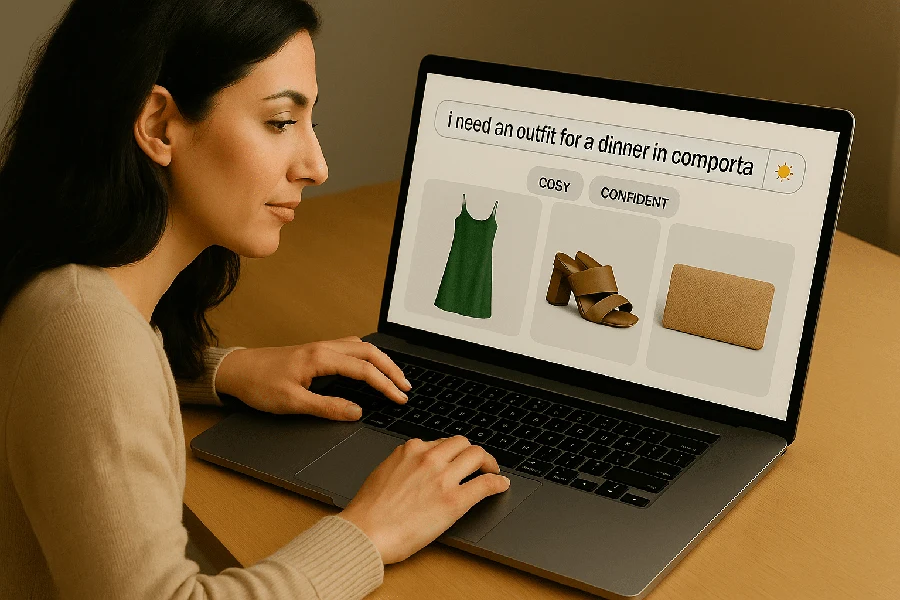

How to help AI make better decisions for fashion shoppers
Your product page was written for a person who was already looking at it.
That reader is disappearing. Increasingly the thing reading your catalogue is an agent that will never see your photography, your fit notes, or the way you merchandised the outfit beside it. It reads fields. Then it makes a choice on your customer’s behalf and moves on.
The instinct is to give it more description. Richer attributes, better tags, finer categories. That makes products easier to find. It does not make them easier to choose between, and choosing is the entire job now.
Consider what choosing actually requires. A customer describes an outdoor wedding in August and says she wants to look elegant without feeling overdressed. Now change one detail. The wedding is black tie. Or she wants something more understated. Or her size is sold out.
Which recommendation should change, and what makes the alternative a better choice? None of those answers is a property of a single garment. They are all comparisons.
The catalogue describes each item on its own
Retail catalogues were designed to support inventory management, navigation, filters and search. They identify products through fields such as category, size, colour, material, price and availability. Those fields remain essential. They establish whether an item is in stock, meets a budget, or belongs to the right category.
But every one of those fields answers a question about one product in isolation. A shopper making a decision is never considering one product in isolation.
Consider two navy blazers with similar prices and fabrics. Both are described accurately. One has a relaxed shape that works with jeans and trainers; the other has sharper tailoring suited to a formal office. A shopper asking for “something smart but approachable for a first day at work” needs the distinction between them, along with an explanation of why one fits better. A filter places both in the same results, because on paper they are the same garment. One of them is right and one is a mistake, and nothing in the product data says which.
Retailers do hold this knowledge. It sits in imagery, in editorial copy, in the judgment of a stylist, in the way a buyer put the range together. It rarely exists as consistent, reusable information across the whole catalogue. If an AI assistant has to infer occasion, styling or the impression a garment creates from a photograph and a sparse description, it can produce plausible advice without reliable support.
AI shopping turns product discovery into a comparison of choices
The change is already visible in commerce infrastructure. Shopify’s documentation for agentic storefronts states that products syndicated to AI channels are listed by default with their title, description, options, images, price and availability. OpenAI, launching product discovery in ChatGPT, describes shoppers saying what they are looking for, refining it in conversation, and comparing options side by side. These developments make clear why accurate feeds matter. They also show where conventional product data stops: knowing a garment’s properties is different from understanding its role in a particular wardrobe or occasion.
A useful fashion assistant should be able to answer questions such as: Which dress looks understated rather than dramatic? What jacket works with it if the evening gets cooler? If the preferred size is unavailable, which alternative preserves the same look?
The answer depends on context, not a universal ranking. A linen jacket may be ideal for one setting and a poor choice for another. “Similar” items may share a colour or silhouette while serving very different purposes.
From a list of attributes to a map of relationships
Making a catalogue decision-ready requires more than adding adjectives to product descriptions. Retailers need to connect product attributes with occasions, style impressions, shopper constraints and other products. The connection matters: a shoe can complement one dress and clash with another; a different shoe may be a suitable substitute under a tighter budget. An alternative should be judged against the shopper’s intent, not only its visual similarity.
In practice, the difference looks like this. The same navy blazer, as the catalogue holds it today:
Category: Blazers · Colour: Navy · Material: Wool blend · Size: 8–16 · Price: £189 · In stock
And as a decision-ready record:
Structured, modern cut. Reads polished rather than corporate. Suits an investor meeting, a first day in a formal office, or a smart evening. Less severe than the peak-lapel alternative at the same price. Works with the straight-leg grey trouser and the leather loafer; too sharp for the relaxed denim it sits beside in search results. If sold out, the charcoal single-breasted preserves the same impression at a slightly lower price.
The first record describes an item. The second lets an assistant defend a choice. Notice how much of the second record is about other products.
The information must be dependable. Size, stock and price need frequent updates. Style and occasion labels should have clear definitions and room for editorial judgment: “formal” means different things across brands, cultures and events. Where a recommendation rests on uncertain visual interpretation, the system should avoid presenting that interpretation as a verified fact.
Why this matters for retailers
Better decision information can serve the same catalogue in several places: on-site search, styling tools, recommendations and the product feeds used by AI shopping services. It gives retailers a way to express their own merchandising judgment consistently as shoppers move between channels. It also makes comparison more useful: an assistant can explain what changes when a shopper chooses one item over another.
That is the layer Selectika is building. We turn fashion catalogues into what we call a Fashion Decision Graph — using proprietary multimodal fashion intelligence and real commerce data to understand each product, and the relationships between products, shopper intent and context. So instead of simply knowing that something is a navy blazer, Selectika understands that it is modern, structured, appropriate for an investor meeting, less corporate than the alternative beside it, and works particularly well with a specific trouser and shoe.
Your catalogue already contains the products. What it is missing is everything that sits between them.
Curious what your own catalogue looks like as a decision graph? We can show you, on your products.